
jacha the ape man potgieter

jacha the ape man potgieter

Jacha ‘The Ape Man’ Potgieter is a conservation artist, conservationist, entrepreneur and all round animal lover. I challenge you to find someone more passionate about the conservation of apes. Born and raised in South Africa, Jacha now lives in Snowdonia with his Welsh wife Gwynneth.

Together they run businesses at the Betws-y-Coed Railway Station including the Alpine Coffee Shop, Hangin’ Pizzeria, the Alpine Apartments accommodation and Platform Galeri, 100% palm oil free businesses. It took them two years to replace all products containing palm oil in their businesses but they’ve successfully done it, proving that viable alternatives do exist. https://www.betwsrailwaystation.co.uk

In this short film, a conversation with Jacha, he speaks about his art, his motivation and what drives his action. From creating sculptures from used plastic to fund-raising and volunteering at ape refuges, his action is extensive, inspiring hope and motivation to make a difference. We’re fundraising for Ape Action Africa through this film, hoping to make a difference in our own small way. Please support this campaign and donate to an incredibly worthy cause. 

https://www.justgiving.com/page/ape-action-africa/

coming home

coming home

'Coming Home - Returning White Storks to the Land' is a short film about the relationship between Dorette, her...

read more
coming home

coming home

‘Coming Home – Returning White Storks to the Land’ is a short film about the relationship between Dorette, her daughter Eti, White Storks and their land. In May 2025 Dorette and Eti released 10 captive bred White Storks from their aviary in North Devon, in the hope that they would establish a breeding colony, returning White Storks to the Devon landscape for the first time in about 600 years.

In the news:

BBC Spotlight (Starts at 05:05) https://www.bbc.co.uk/iplayer/episode/m002dfz0/spotlight-late-news-13062025 BBC https://www.bbc.co.uk/news/articles/cp85dynz32po Fox41 https://www.fox41yakima.com/storks-return-to-skies-after-600-years-thanks-to-rewilding-effort/ Facebook https://www.facebook.com/watch/?mibextid=wwXIfr&v=722790163779478&rdid=Bppo9knY8x9AkPTs

Press release:

Storks have returned to part of the UK after 600 years thanks to an “extraordinary” rewilding effort. Ten white storks have been released at a satellite site of the Keep It Wild Species Recovery Centre in north Devon.

The site, which lies within a privately owned rewilded farm, marks the first successful reintroduction of the birds in this part of the UK for hundreds of years. Storks, tall wading birds known for their black-and-white plumage and impressive wingspan, were extinct in Britain by the 1400s due to hunting and habitat loss. Now Devon has joined a movement across Europe which has seen areas, including Sussex, restoring the birds’ wild populations.

The birds were raised in two large aviaries at the South West site, where footage shows landowner Dorette Engi feeding them in the open aviary before the soft release. Dorette and her children have spent several years rewilding her land, which now includes recreated wetlands, mixed grasslands and restored woodlands. She explained: “These birds haven’t lived freely here in over 600 years, yet as soon as they were given the choice, they stepped out into the landscape like it had always been theirs. “They’ve taken to the thermals, they’re foraging confidently – they seem utterly at home. It makes you realise just how ready the land was to welcome them back.”

Locals are already reporting sightings of the birds. Dorette added: “Seeing them above the tree line, circling with effortless grace, it takes your breath away. It feels like new life, and hope.” Some of the birds were bred at the Rewilding Coombeshead site near Lifton, in partnership with author and rewilding expert Derek Gow.

Derek, known for his work restoring species such as beavers, wildcats and water voles, is based at his Rewilding Coombeshead site. He says storks have a key role to play in reshaping how we think about wildlife in Britain “We don’t need to manage every moment of a wild animal’s life, we need to give them the space and conditions to manage themselves. Storks are scavengers, foragers, and brilliant natural indicators of healthy ecosystems. If they thrive here, it means the land is coming back to life. These birds connect us to a time when wild animals were part of the living countryside. But it’s not about nostalgia – it’s about function, and restoring the full richness of our ecosystems.” This project has been intentionally kept quiet to allow the birds to settle without disturbance, and the storks released from the North Devon site are not tracked with GPS – which the recovery centre says allows the animals “full autonomy”.

Film Produced, Directed, Filmed & Edited by Deryck van Steenderen Cameras Poul Brix and Sacha Dench Music ‘Epic War Trailer’ by Alexey Mirenkov (BMI), bought and licensed for use from Pond 5.

coming home

coming home

'Coming Home - Returning White Storks to the Land' is a short film about the relationship between Dorette, her...

read more
director’s fashion film playlist

director’s fashion film playlist


The fashion film director’s playlist is hosted on my YouTube Channel. This is a compilation of fashion films, branded content and online commercials that I have made.

coming home

coming home

'Coming Home - Returning White Storks to the Land' is a short film about the relationship between Dorette, her...

read more
director’s general playlist

director’s general playlist

This director’s playlist is hosted on my YouTube Channel This is a compilation of short films, branded content and online commercials that I have directed. I will break this down into categories in future posts for more specific viewing.

coming home

coming home

'Coming Home - Returning White Storks to the Land' is a short film about the relationship between Dorette, her...

read more
gore® wear ss19

gore® wear ss19

In September 2018 I had the privilege of directing the shooting of the new Gore® Wear SS19 range of Fast Hiking and Trail Running clothing online commercials, purpose made outdoor apparel for extreme athletes.

The shoot was set in the beautiful and formidable Dolomites in South Tyrol, Italy, a UNESCO World Heritage Site, perfect for the challenges Gore® Wear is made for.

This shoot was one of the most physically challenging shoots I’ve ever done, due to the altitude we worked at (I live at sea level!), but the results speak for themselves. Working with the right crew and talent makes all the difference. Huge respect to DoP Vale Rapp, his handheld tracking shots are the smoothest I’ve ever seen and his drone work outstanding! This was the first time that I worked with the DJI Mavic 2 Pro, featuring the collaboratively developed Hasselblad L1D-20c and the quality is exceptional.

Credits:

Client: Gore® Wear

Agency – 1000heads

Director – Deryck van Steenderen

DoP – Vale Rapp

Sound – Stephan Wieser

Editor – John Foxton

Stills Photographer – Harald Wisthaler

Fast Hiking Athletes: Eva Sperger and Jamie Ramsay

Trail Running Athletes: Yoann Stuck, Zac Marion and Amanda Basham

Location: Dolomites, South Tyrol


coming home

coming home

'Coming Home - Returning White Storks to the Land' is a short film about the relationship between Dorette, her...

read more
the cheetahs of the kgalagadi

the cheetahs of the kgalagadi

Written for National Geographic Kids magazine

THE KGALAGADI IS HOME TO ONE OF THE MOST IMPORTANT CHEETAH POPULATIONS IN AFRICA, BUT WE KNOW PRACTICALLY NOTHING ABOUT THEM. A NEW PROJECT IS SET TO CHANGE THAT.

A springbok herd is grazing peacefully in the hot mid-morning sun, the dust irritating their nostrils. Suddenly a cheetah explodes from the grass she has been hiding in. Stealthily she has been stalking the herd from a downwind direction. The springbok run for their lives. Within seconds the cheetah is at full speed, targeting a springbok ram.

The dark stripes below the cheetah’s eyes absorb the harsh sunlight, helping her to see clearly in the bright light. With the cheetah’s long legs moving in a blur, she rapidly gains on the springbok, her flattened tail guiding her like a rudder. Without breaking her stride she pounces, sinking her sharp canines into the back of his neck, avoiding the springbok’s hooves and sharp horns.

The sprint has exhausted her but this time she was lucky and her cubs will eat. Her slim body is built for high speed, making cheetahs the fastest animals on Earth, but they cannot maintain the speed for long distances. If they miss in their sprint, they must stop to rest before they can hunt again.

After catching her breath, she called to her cubs who were hiding under a nearby camel thorn tree. Cautiously they came out. Knowing that lions, hyaenas and jackals would be attracted to the scent of blood, they eat quickly. Sometimes they are chased away and have to watch from a distance as their competitors eat the kill their mom worked so hard for.

Watching from a safe distance is Dr. Gus Mills and his team. They are doing research on the cheetah of the Kgalagadi Transfrontier Park.

Watching you watching me

The Kgalagadi Rransfrontier Park is about 38 000 square kilometers and is one of the largest conservation areas in the world. About two thirds is in Botswana and a third in South Africa. It is called a transfrontier peace park because it crosses a national boundary but there is no fence – just some whitewashed stones to mark the border. Because it’s such a large protected area the cheetahs are able to live without conflict with humans, but it’s a population that we know virtually nothing about.

“We’re concentrating on the South african side because of the huge size of the park, using a combination of traditional and hi-tech tracking methods to monitor the cheetahs,” says Gus Mills.

Working with Khomani San trackers and with the use of radio collars, GPS and digital cameras, they are able to monitor the movements and behaviour patterns of individual cheetahs. Gus reckons that there are about 80 cheetahs in the park. even though it is just a year into a five-year project, they have already found out some interesting things.


Hare raising snack

“We thought springbok would be a key prey species, probably the most important food for cheetahs,” explained Gus. “but it doesn’t seem as though this is the case. The cheetahs are feeding on quite a wide variety of food items including animals that we didn’t expect, such as springhares. They are a very important prey and nocturnal and so the cheetahs are hunting at night.

Hares and springhares actually make up the majority of their kills, although because of their small size it means they have to kill more often. They also feed on species like steenbok and duiker. The project team have observed quite a few male cheetahs going for eland calf, which is a really big prey.

The eland have moved south in the park due to the dry conditions further north and so are probably in a weak state.

“The Kgalagadi cheetah may not be as dependent on springbok as we thought they were. It may be that when females have cubs, springbok become very important. It’s all very well snacking on springhares if you’re on your own but when you’ve got kids to feed, a springhare just won’t do,” says Gus.

Going solo

Each cheetah female lives on her own, but some males form groups of two or three called a coalition.

“We have two males collared,” says Gus, “a solitary male and one from a coalition of two. These two cheetah groups appear to have overlapping territories in the southern Auob. The coalition have recently moved into the area inhabited by the single male. Perhaps they will force him out.”

Cheating the lion

A lot of cheetah cubs die young. In the Serengeti, only about five per cent of cubs born there become adults. Most are killed by lions. In the Kgalagadi the population of lions is smaller and more spread out, so there is less pressure on cheetah cubs.

To date Gus has come across one adult male cheetah killed by a leopard. The team suspects that he was injured by one of the male cheetahs from the coalition.

“The cheetah had been chased for about 250 metres. A cheetah should be able to outrun a leopard at that distance so we presume he wasn’t in good condition,” recalls Gus.

Battle of the sexes

In normal carnivore populations there are more females than males. However, towards the beginning of the project it looked like there were two males for every female. As the project progressed the ratio was looking less unusual. Perhaps the females are better at hide-and-seek!

There’s still a lot to learn about how cheetahs survive in such harsh conditions. Gus and his team will be conducting research for another four years. It’s hard, hot work, but for them watching the beautiful sprinters in this peaceful place is a labour of love.


coming home

coming home

'Coming Home - Returning White Storks to the Land' is a short film about the relationship between Dorette, her...

read more
lost in silence

lost in silence

Written for Xplore Magazine

The trip to Twee Rivieren, gateway to the Kgalagadi Transfrontier Park from South Africa, took 15 minutes too long. I’d allotted what I’d thought was plenty of time for the trip from Cape Town – 10 hours – but with the roadworks delays I missed the gate closing time. By a mere quarter of an hour. I phoned – no answer. I hooted – silence.

Just as I was beginning to wonder where I was going to spend the night, a smiling face appeared in the twilight. It belonged to SAN Parks staffer Marius Kroon, who performed the magic rite and swung the gate open.

Twee Rivieren is the administrative centre of Kgalagadi park. As such, it’s large and well organised, dotted with attractively designed, limestone-clad buildings, is just the place to throw off a city schedule. My first priority now I’d finally arrived was to stop rushing. My second was dinner.

The Lion’s Deck’ restaurant in the camp was busy and generally bookings are essential, but my luck held and I was found a table. As the staff scurried off to fetch me a beer and organize a rump steak, I finally slowed down, switched off the city schedule and started to unwind to the quiet of the Kalahari.


deryckvs-kgalagadi-N1f1010006
previous arrow
next arrow


The Kgaladai Cheetah Project

In the morning I belatedly registered with reception, and enquired where an old family friend who was working with cheetahs in the Kgalagadi might be found. Gus and Margie Mills, are authorities on predators and have done extensive research in the park, as well as Kruger, on a range of South Africa’s charismatic predators. Currently they are employed on the Kgalagadi Cheetah Project, sponsored by the Tony and Lisette Lewis Foundation South Africa.

When I told Gus and Margie I was heading north to Kalahari Tented Camp, a wilderness unfenced tented camp north of Nossob Camp, they asked me to look out for cheetahs with a collar. “Though I wouldn’t hold your breath,” said Gus. “We only have two individuals collared in a 10 000 km2 area.” Bouncing north along the rutted dirt roads, I drank in the surroundings. The sun infiltrated the land- scape, banishing midwinter’s chill from the air – or maybe that was the seat warmers. A short way out of camp I came across two cheetahs lazing in the shade of a Camel Thorn tree. It seems today would be my lucky day too – one was wearing a radio collar. They were in no hurry and neither was I.

Arriving in the Kalahari Tented Camp with half an hour of daylight left, I decided it prudent to drive through to Mata Mata, three kms away, to fill up with diesel. There are only three camps that supply fuel in the Kgalagadi: Twee Rivieren, Mata Mata and Nossob. They are also the only camps with shops, stocking the basics although these tend to be on the pricey side – but then this is a long way from anywhere.

The six wilderness camps in the South African side of the Kgalagadi are all intimate and unfenced. Kalahari Tented Camp, the largest, consists of 15 stilted canvas tents overlooking a waterhole in the Auob River. The fully equipped tents sleep two to four people and have their own bathroom and kitchen. Having experienced the freezing cold Kalahari nights I was grateful to see ample blankets in the tent. Be warned, however, that there are not any power outlets for conventional plugs. So, no recharging your cell or laptop. Not that there’s cellphone reception anyway – that’s limited to Twee Rivieren, making Kgalagadi one of the few places in South Africa where you can escape the insidious reach of the airwaves.

The following morning, I’d arranged a special short veld lesson from warden Piet in the camp surrounds. The tracks around the camp were plentiful, a testimony to the wildness of the wilderness camps. Piet was born in the Kalahari, hailing from the Mier community, and in an animated way shared his knowledge of and affection for the Kalahari with me. Taking the camel thorn tree, one of the most common trees occurring in the park, Piet teased out the micro- ecosystems in decaying fallen branches with his finger, showing why collecting firewood in the park is prohibited.

The road to solitude

Leaving the Kalahari Tented Camp I travelled across to Nossob, a camp midway on the Twee Rivieren to Union’s End road. I was heading to Gharagab Wilderness Camp, in the north of the park, just below Union’s End and on the border with Botswana. Gharagab is accessible only by 4×4 and the park requires you to check in at Nossob before heading on the trail.

The landscape changed quickly on the quiet road up to Union’s End. After popping in at Grootkalk to drop off some brake fluid for the camp warden, I turned onto the Gharagab 4×4 trail, which winds its way through the wilderness. For the first time since entering the park I felt utterly alone; my reliance on the Pajero was absolute. The trail to Gharagab is only 32km long, but at a comfortable travelling speed of 20km/h takes more than an hour and a half. A black-backed jackal trotted down the track towards me, completely indifferent to my approach. As it reached me, it disdainfully left the track, making off into the landscape. The solitude was medicine for my city-weary soul.

I arrived in Gharagab at about 17:30 where camp warden Eric showed me to a small two-bed, log-walled, self-catering unit with a tented roof. I dumped my gear and headed for the lookout tower on a small hillock behind the camp. As I clambered up the rough-hewn log steps, a 360-degree vista unfolded before me. Today I’d arrived just in time. The sun was wallowing on the horizon as if reluctant to depart the day, setting the trees and grasses alight. Slowly it succumbed and night wrestled over the landscape. I became lost in my thoughts, my camera lying unused in hands grown quiet.

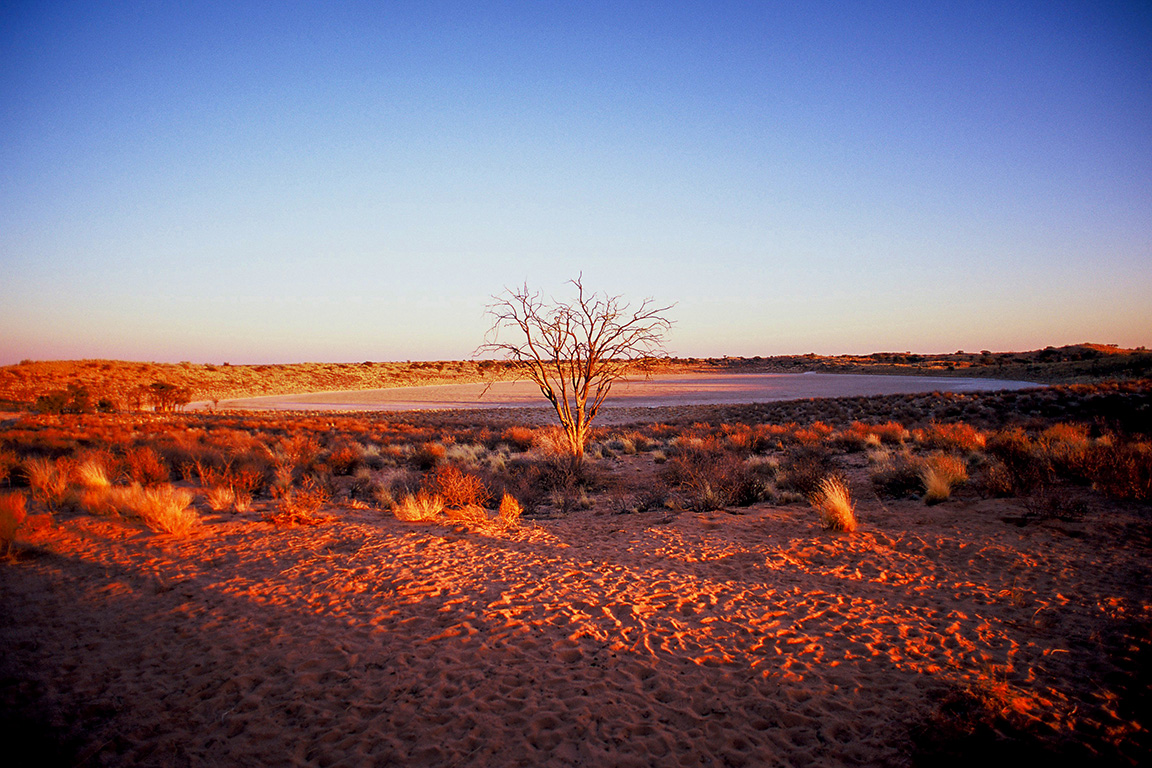
The 4×4 trail that leads from Gharagab back to the main road is a lot more challenging than the road into camp. Although it’s only 29km, progress is slow and you’ve plenty of time to smell the camel thorns, the dune dust, the grasses. Three dunes need to be negotiated on the way out, each one requiring different 4×4 gear combinations. My faith in the Pajero held: Pajero 3, Kgalagadi 0. After reporting at Nossob, refuelling, lowering the tyre pressure from 180 kPa to 150kPa and stocking up from the shop, I left Nossob through the back gate. I was aiming for the Bitterpan 4×4 trail, but found myself at an unmarked fork in the road. Taking a flier, I followed the tracks leading off left into the dunes; it was a fortuitous guess and I was on the trail. Two-and-a-half hours and 53 kilometres later I’d traversed through rolling grasslands and had good sightings of red hartebeest, steenbok, gemsbok and eland.

The wilderness camp of Bitterpan overlooks a huge pan. The entire unit is built on short stilts and is far more communal in nature than the other wilderness camps. Being my third day solo in the Kgalagadi, I was looking forward to sitting around a fire with fellow travellers. As I was introducing myself, one of the other guests called out that she’d just seen lionesses on the ridge behind camp. We all leapt up to have a look. Sure enough there they were, nine in total sauntering down the road towards camp.

The lionesses came right into camp to drink from a small watering point behind Willem, the camp warden’s cabin. As the lionesses approached, he dashed across to fetch his rifle and was now peering round his door, keeping an eye on them – and us.

Half an hour and many photographic frames later, the lionesses mooched off, most likely to the waterhole on the pan itself. We ventured out of the protective surrounds of camp to the fire area and soon had a good blaze going. A Northern Karoo farmer and I were sitting jawing about sightings, preparing to cook our well earned steaks, when out of the darkness we heard a sneeze. We grabbed our torches to investigate, only to find a few pairs of eyes glowing back at us. The lionesses had finished at the waterhole and stalked us in the darkness… Cautiously we got up and retreated to the deck, careful not to make any sudden movements. As we moved back the whole pride moved forwards, coming into the firelight.

The lionesses, it seemed, were in a playful mood and in no hurry to move on. Circling the camp, they tackled the low stick fence that lines the entrance track, prizing sticks from the fence for a game. Only after much romping and tussling over possession of the sticks did they finally move off into the darkness.

Full of bravado we headed back to our fire to braai our steaks. After all, we would be safe next to the fire as lions are scared of fire, right? By we, I mean three out of the seven guests. The others remained safely ensconced on the deck behind us peering anxiously into the darkness lest the lionesses return.

The next morning I went to the fireplace, surrounded by the soft red sand of the Kgalagai, to look at the lion tracks. I paced the distance off from where we were sitting next to the fire to where the lioness had sneezed whilst lying prone. 15 meters. A lioness could cover that distance in a second. Quite literally saved by a sneeze!

I said my farewells to my fireside compatriots and the Kgalagadi itself. It was time to head home. Time to get back into cellphone reception and no doubt a stack of messages. Time to face city reality once more.

As I dawdled down to Twee Rivieren black-backed jackals, blue wildebeest, gemsbok, ostriches, steenbok, springbok, a Cape fox and an African wild cat all made appearances. How could I not stop?

On the way out I stopped at Gus’s office to tell him about our fireside sneeze. He roared with laughter and said to me, “Didn’t you know that the Kalahari Black mane lions are not scared of fire?” I do now.

Eventually, with Twee Rivieren behind me, I hit the tar and my messages. But once the Kalahari dust has seeped into your blood, it beckons for your return. I long for the solitude of the Kgalagadi, that place of peace.

coming home

coming home

'Coming Home - Returning White Storks to the Land' is a short film about the relationship between Dorette, her...

read more
redefine pretty by em ford of my pale skin

redefine pretty by em ford of my pale skin

Does a film have the power to change the world? I believe it does.

When you’re making a film and pause, look around the set and see the crew completely quiet, fixated on what we’re shooting, some with tears in their eyes including yours, then you know that this is the one.

There’s a film I’ve been working on with Em Ford of My Pale Skin Blog, Director, blogger, YouTube #CreatorsforChange and influencer.

It’s the film that’s going to break the internet.

If you don’t believe me, see for yourself.

Photo of Aisha by Em Ford

coming home

coming home

'Coming Home - Returning White Storks to the Land' is a short film about the relationship between Dorette, her...

read more
the decisive moment

the decisive moment

Henri Cartier-Bresson coined the phrase the decisive moment, particularly in relation to his street photography he became so famous for. Photography is all about the decisive moment, that split second in time in which the photographer chooses to create the image. It’s difficult to teach someone when to press the shutter release button to create an image, the decisive moment comes intuitively. Photographers have to learn to trust our gut as to when that decisive moment that creates magic is and react instinctively.

The other day I went for a walk on my own at sunset. I had been filming the new hovercraft in Portsmouth that runs from Portsmouth to Ryde on the Isle of Wight and it looked like it would turn out to be the perfect evening. It did and people came down to the beachfront to enjoy the sunset. The light kept getting better and better and I kept shooting. As I was about to leave I noticed a man in a turban looking out over the channel. His profile was striking and his pose almost regal, majestic. I shot a few frames of him excited about the shot. I shoot with both eyes open, a skill that took practice to perfect. The benefit of doing it is that you can still use the peripheral vision in the eye not looking through the camera’s viewfinder. I noticed two young women pushing a pram walking into the background and waited for the decisive moment in which magic is created…


coming home

coming home

'Coming Home - Returning White Storks to the Land' is a short film about the relationship between Dorette, her...

read more
allier, à la recherche de soi

allier, à la recherche de soi

“Allier, à la recherche de soi” [Allier, in search of self], is a fine art photography project created in the Allier region of France in 2015.

The body of work is a self-reflection, a time of deep internal turmoil and soul-searching, at a crossroads in life, decisions that will change the course of life forever.

The artworks in this series are collectible original 1/1 giclée prints available to BUY through Saatchi Art. There are no editions. The artist’s final proof becomes the final signed artwork if I approve it. All other works leading up to the final artwork are destroyed.

The body of work is a self-reflection, a time of deep internal turmoil and soul-searching, at a crossroads in life, decisions that will change the course of life forever.

Sometimes the loneliest road is the road we travel surrounded by people, oblivious.

The landscapes were created alone. Whilst wandering and wondering alone. An attempt to capture and portray the inner turmoil I felt whilst at the same time paying homage to Allier, a region of great beauty.

The intention is for the viewer to question, both the medium and the expression. The medium is chosen to confuse and delight, with the appearance of a water colour painting but the realism of a photograph.

There is a 7cm white border surrounding the print that means that the actual image size is 87.6cm high x 131.4cm wide with the total artwork size being 101.6cm high x 145.4cm wide. I title and sign the final original approved print in this border.

There is only one original 1 of 1 artwork per scene, Giclée print on Museum grade 310 g.s.m. 100% cotton fine art and photo paper, with beautifully warm off-white tones and extreme texture. One final collectible original artwork is created, printed to archival standards.

I reserve the right to use copies of the artworks for self promotional purposes, editorial and publishing use but guarantee not to print another fine art copy of the work. Should you choose to buy an artwork you are buying the artwork itself, not the intellectual property to the artwork. The copyright remains mine, my Human Right, for the sake of humanity. Should the artwork be damaged, lost or destroyed it will remain just so.

coming home

coming home

'Coming Home - Returning White Storks to the Land' is a short film about the relationship between Dorette, her...

read more
50point5

50point5

50point5 is a fine art photography project that examines the barriers that divide the people of South Africa as a result of apartheid. It is a project of love and loathing that I have been working on for over seven years.Love for the people of South Africa and the art of photography. Loathing for apartheid and what it did to the people.

deryckvs-50point5-08
PlayPause
previous arrow
next arrow
deryckvs-50point5-08
deryckvs-50point5-27
deryckvs-50point5-35
deryckvs-50point5-44
deryckvs-50point5-49
previous arrow
next arrow

The images were created along the 50.5km route from my former home in Vredehoek, Cape Town, South Africa, to a private university in Stellenbosch, one of the wealthiest towns in South Africa, where I lectured in photography on a part time basis for five years. The route took approximately 45 minutes to drive, depending on traffic, giving me time to observe and think. The reality of post apartheid South Africa is blatantly clear along this route with the route running from affluent areas, overlooking the former District Six leaving Cape Town, townships, past the Cape Town International Airport, more townships, farmlands in the wine route, finally arriving at the office park where the university is based that overlooks an access controlled private residential golf estate surrounded by electrified fencing and patrolled by armed guards.

The gap between the haves and the have nots is extreme with the poor living in abject poverty in shacks, entire families sharing a shack, whole communities sharing rows of prefabricated toilets and communal water stand pipes. Serious crimes like rape and murder occur daily, seldom, if ever, featured in the news. The police are so overworked that criminals literally get away with murder. Shack fires occur frequently often destroying hundreds of shacks per fire, the people losing everything they own in the fires. Education at the majority of township schools is poor with teachers often not arriving for work, teen pregnancies high and violence commonplace. The government’s answer to the education crisis in South Africa was to lower the pass rate required to finish high school so that more pupils matriculate.

The wealthy live in luxury protected by private security companies, often in access controlled electrified fenced private estates patrolled by armed guards. Domestic servants (gardeners and maids) come from the surrounding townships to work for the wealthy, often for minimum wage, returning to the townships in the evenings. The extreme in this daily journey from township to private luxury back to township must be mind bending, driving home the inequality as a result of apartheid.

The project comprises of a BOOK of 50 and a half images as well as limited edition fine art gicleé prints, available in a series of a maximum of five prints per image.

Read more about the project here.

coming home

coming home

'Coming Home - Returning White Storks to the Land' is a short film about the relationship between Dorette, her...

read more
must watch: dark side of the lens

must watch: dark side of the lens

I’ve added a new “Inspirational” category to my blog to share some of the things that inspire me as a photographer and film maker in the hope that they will move and inspire you too.

One of my all time favourite indie films is the multi award winning surf film “Dark side of the lens” by Mickey Smith of Astray Films. The film is beautifully made and gut punches me every time I watch it. Mickey perfectly captures why it is that he does what he does, reminding me of why I chose to become a photographer.

“I see life in angles. In lines of perspective. A slight turn of the head, the blink of an eye. Subtle glimpses of magic other folk might pass by.”

“Cameras help me translate, interpret and understand what I see, it’s a simple act that keeps me grinning.”

“I try to pay tribute to that magic through photographs.”

Stop what you’re doing and watch it now. I insist.


hasselblad and the rain

hasselblad and the rain

I’ve always been a big fan of Hasselblad. Their quality and craftsmanship combined with their relentless pursuit of excellence works for me.

The first Hasselblad I ever bought was a second hand ELX. A clever camera technician jippoed the battery compartment for me so that I could use a 9v battery in it and I shot on it for years. My second Hasselblad was a 500C/M, the AK47 of medium format photography. Manual beauty. I’ve always wanted a 503CW with a pistol grip, they’re as scarce as hens teeth.

The arrival of digital slowed down my Hassleblad purchases due to the cost but when Michael North of Hassleblad South Africa recently offered me the chance to test the new Hasselblad H5D-50C I grabbed it with both hands. The question was, what to shoot?

Presented with an opportunity like this I didn’t want to waste it. Cirque Magazine was doing a fashion story on Norwegian Rain, a clothing range from Norway designed by T-Michael that debuted in South Africa at the Mercedes Benz Bokeh Fashion Film Festival that was the perfect fit I thought. Shoot Scandinavian fashion with a Scandinavian camera.

Norwegian Rain specialises in rain coats since they live and work in Bergen, the town with the highest rainfall in Norway. Visions of a grey day preferably pouring with rain swirled through my mind. The shoot date set, perfect location secured and models and crew in place we were set to go. I even had his and hers umbrellas in the kit as props.

Cape Town is a city well known for it’s ‘four seasons in one day’ weather. I’ve always had the most incredible luck with good weather for my shoots and this day as no exception. Mid winter in Mediterranean climate (rains in winter) Cape Town the sun shone and the sky was pure blue. So much for the grey day my heart was yearning for.

Enter the thing (apart from the quality!) I love most about shooting on Hasselblad. Leaf shutter lenses. When I need to shoot with the shallowest depth of field possible combining natural light with portable flash (strobe) there is nothing like leaf shutter lenses to give you maximum creative control. Standard on Hasselblad. I said a silent prayer of gratitude for having the right camera in the bag for the job.

The Sunshine Company, distributor of Hasselblad in South Africa, gave me their newly arrived Profoto Pro B1 500 Air TTL Battery Flash 500W portable lights with lithium batteries to test with the Hasselblad. Off-camera flash. With TTL. Without cords. Nice. I’ve been working with Profoto lights, the standard in lighting rental in South Africa, for years. As an assistant I carried more packs and batteries up and down Clifton 2nd beach stairs than I care to remember. I’ve never had need for a gym membership.

When picking up the gear, the lads ran through it with me.

“Where are the packs?” I asked. They laughed at me.

“The batteries are on the heads!” they replied.

I had visions of what look like mini car batteries stuck to the heads. Clement showed one of the batteries to me. It was tiny by comparison to it’s predecessors.

“How long will it last?” I asked, the concern obvious in my voice.

“220 full-power flashes per charge,” he laughed.

“Can I take an extra spare to be sure?” I’m not a big fan of a battery dying on me at exactly the same time that everything comes together for the perfect picture.

The Pro B1 lights come standard with the Profoto Air remote TTL, an adjustable wireless remote trigger that can adjust the power of the lights proportionately while you’re shooting based on your TTL light meter. I’m too much of a control freak for that and prefer shooting on manual. What is really cool about it is that you can adjust the power of the lights up or down using the remote and it does it proportionately, keeping your lighting ratios the same. Nice. Less running on set required.

Shooting on the Hasselbald H5D-50C was pure pleasure for me. Being a professional photographer means I’m a professional crisis manager as there are so many factors that have to come together for a shoot to work. The better the gear, the easier it is to cope with changing conditions. My beautiful grey, raining day that I envisioned turned into blue skies and sunshine. To shoot rain coats in. Without the budget for a water tank. I’m always up for a challenge but there are challenges and then there are challenges. My favourite lens for shooting fashion with my film Hasselblads is the 150mm due to it’s perfect flattering perspective. I made sure there was one in the bag but never used it. The Hasselblad HC 80MM/f2.8 lens was a dream to work with. The True Focus system is a pleasure enabling the re-composition of the image without losing the focus point and there was no noticeable perspective distortion, allowing me to include the architectural shapes of the location, the reason I chose it in the first place.

The shoot over I reluctantly returned the gear having changed the batteries only once on the lights. I’m not big on shooting thousands of frames for one shot but I was surprised. Not as surprised as the MyCiti employee who locked herself in the staff toilets on location by accident, who we had to rescue, but surprised nevertheless.

The biggest dilemma followed in post production. The images were so sharp, with so much detail that they created the temptation to retouch and retouch, and retouch some more. I’m not a big fan of over retouched images, preferring to keep an element of realism in my work, but when presented with such fine quality there’s an OCD tendency that creeps in to just keep going. OCD under control I managed to tear myself away from the computer and send the finished images, out now in the August edition of Cirque Magazine.

Models: Simone de Kock and Jonathan Guy of Ice Genetics

Hair & Make-up by Samantha Ellenberger

Styling by Bronwen de Klerk

homage to dance

I’ve loved dance music for as long as I can remember. Actually I’ve loved nearly all music for as long as I can remember.

Dance music played a huge roll in my twenty something too much fun years during which I went to just the right amount of dance music events and underground raves and danced my nuts off for hours with people who spent a lot of time touching each other and telling each other how beautiful they are.

Sometimes I create things just for fun, because I can. Not for any particular purpose other then the challenge and fun of doing it. I love messing around with Garage Band and have come up with a style of music I call #ElectroClassicRockDance, basically an eclectic blend of all the musical styles I learned to play and dance to. I’ve never heard of this genre of music before and doubt that it exists outside of my mucking around that I upload to SoundCloud to mess with music purists with.

‘Homage to Dance’ is a marathon piece I composed on very long train journeys to lighten the load. It’s groovy baby!


life, love, the universe and butternut soup

life, love, the universe and butternut soup

There are few things that teach us about life like life itself. I realised a while ago that once you take a stand on something, a belief, philosophy, statement of faith, you will be tested on it. The Universe has a sneaky way of doing this, usually in a subtle way that’s barely noticeable unless you’re aware of it, often with a liberal dash of humour.

My son, David, is an amazing child. He’s also very challenging. He was sent to make me stronger, something that he does on a daily basis. Last night I was cooking supper, freshly made butternut soup, while I was helping him with a school project on leopards. The idea was that he would use my computer for research while I was preparing the soup. For some unfathomable reason women seem to think that men are lying when we say that we cannot multi-task. We can’t. Seriously.

I wasn’t concentrating on cooking properly as I was fielding David’s constant barrage of questions and insistence for help and mistook cayenne pepper for paprika. David doesn’t eat spicy (burny in his words) food. Realising my mistake on tasting the soup I had to make a plan. Pouring off the liquid I managed to salvage some of the chunks of butternut that were still cooking. I placed these in the blender and topped it up with milk, thinking that the milk would knock the edge off the cayenne pepper remnants. Placing the lid on the blender I felt an all too familiar niggle but pressed play anyway. The lid blew off the blender, covering me and immediate surrounds in boiling hot, blended, supposed to be oh so delicious, butternut soup. I’m doing laundry today. With stain remover.
The resulting butternut soup was still too spicy for David who refused to eat it.

The lesson I learnt from this is simple. When you end up in the pressure cooker and feel that niggle, don’t press play. Stop, take a deep breath, exhale slowly. Listen to your Self. It may save you a lot of laundry. And stain remover.